4.2 Contribution of Moral thinkers and Philosophers from India and World
Normative Ethics Aka Prescriptive Ethics
Deals with what practices are right and wrong and our obligations to others and future generation. The study of ethical behaviour.
- Virtue Ethics
- Person based ie it looks at the virtue or moral character of the person carrying out an action instead of what is their ethical duties and rules or consequences of a particular actions.
- Provides guidance to person as to what is expected of him.
- Deals with the purpose of Human life, meaning of life, Plato Aristotle.
- 7 main virtue ethics are chastity, temperance, charity, diligence, kindness, patience, and humility.
- 4 cardinal virtues Prudence, Justice, Fortitude, Temperance.
https://www.bbc.co.uk/ethics/introduction/virtue.shtml
- Consequentialism :
- Whether something is good or bad depends on its outcomes.
- end should be right means may or may not, greatest good for greatest no of people.
- Ethical Egoism + Ethical Altruism + Utilitarianism.
- Utilitarianism : most good to most number of people
- Jeremy Bentham's Gross or Quantitative Utilitarianism - actions are wrong if it produces pain, each man desires his own happiness.
- 1.1 Deals with maximising happiness for everyone.
- Mills Refined or Qualitative U - qualitative nature of pleasures like intellectual pleasure instead of sensual ones.
- 2.1 Certain pleasures were of greater consequence than others and these higher pleasure could only be recognised by those who have experienced them.
- Jeremy Bentham's Gross or Quantitative Utilitarianism - actions are wrong if it produces pain, each man desires his own happiness.
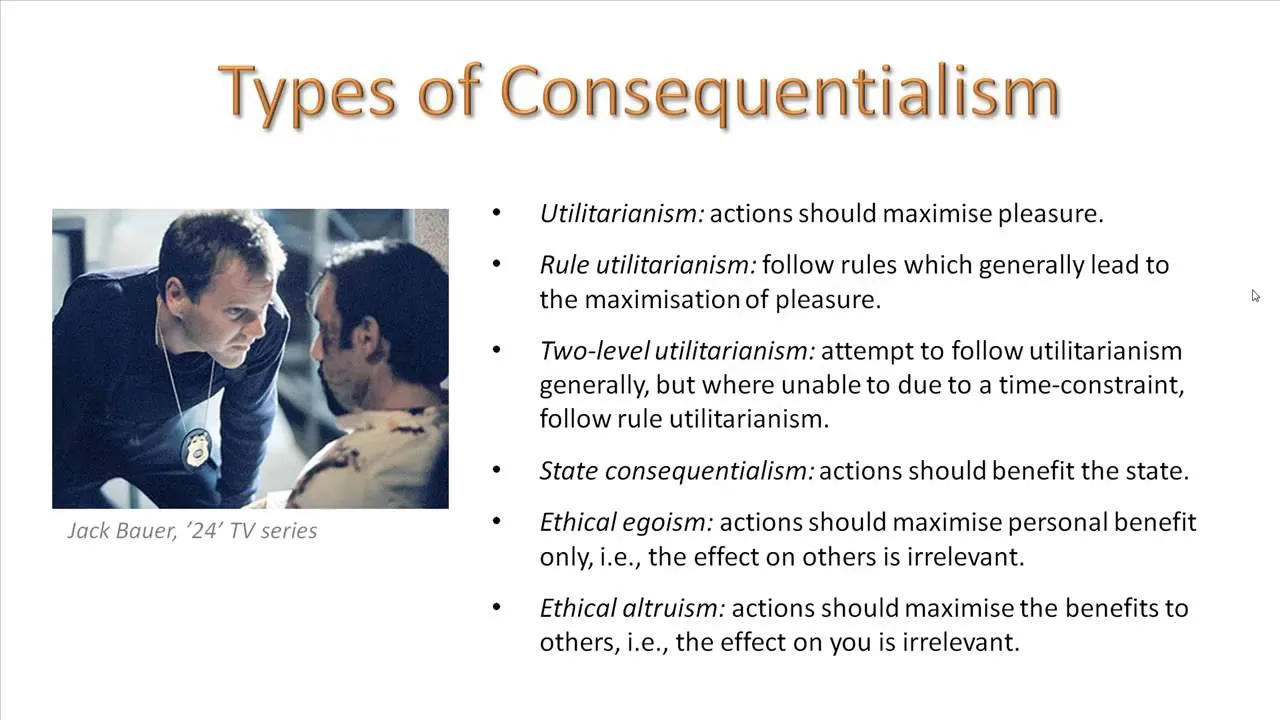
https://www.bbc.co.uk/ethics/introduction/consequentialism_1.shtml
- Deontological or Non Consequential - actions should be right consequences may or may not
- Kantian Ethical Theory : revolves around duty, what to do in certain situations, right and fair on wider level, Categorical imperative - internal law imposed by conscience
- Duties listed by WD Ross : tell truth, right the wrongs done to others, act justly, help other, improve oneself, give thanks, avoid injury to others.
- Plato's concept of virtues - disciple of Socrates, man is social by nature, goodness is in human nature, virtue is knowledge
- 4 imp virtues - wisdom, Courage, Temperance, Justice
- 3 keys to moral life is Passion, Spirit, Rationality
- Aristotelian Concept of Virtue - motives and values are also imp, considers Justice as supreme virtue divides into
- Distributive - equitable distri of wealth and honour,
- Remedial - fair transaction among mem of community Golden mean of excessive indulgence and excessive repression of desire
- Moral Relativism - morality is relative to norms of one's culture, no universal moral principle
- Moral Objectivism - there are universal and objectively valid moral principles that are not related to society
- Moral Absolutism - certain principles are universal and non-over rideable
- Moral Realism - real objective and moral facts or truths in universe
- Moral Subjectivism - moral judgements are only statements of persons feelings or attitudes
- Moral Emotivism - moral claims are expressions of approval and disapproval, does not provide info about speakers feelings just expressions
- Moral Prescriptivism - ethical statements are recommendations
- Ethical/Moral Supernaturalism - Ethics inseparable from religion
- Moral Intuitionism - good and bad cannot be broken into sub components
- Hedonism - all human actions guided by pleasure , pleasure is highest good, type of consequentialism, right action produces pleasure, wrong
- Psychological Hedonism - pleasure is natural object of desire
- Ethical Hedonism - man ought to seek pleasure, p is proper object of desire, Egoistic Hedonism, Altruistic Hedonism
- Indian Philosophy
- Orthodox/ Aastik School, Heterodox/ Nastik School
- Strong metaphysical phenomena, absolutistic and spiritualistic, 4 Purusharthas - Dharma, Artha, Kama, Moksha
- Buddhist Ethics -
- 5 precepts - Not killing other living beings, not taking the not given, avoid sexual misconduct, avoid false speech, abstain from drink drugs
- Jain Ethics - Ahimsa, Satya, Asteya/non stealing, Brahmacharya, Aparigraha
- CharavakaEthics - materialism, atheism, Hedonism, only this world exists, deny Dharma Moksha, physical pleasure is goal of life
- Gandhian Ethics -
- On Moral Behaviour - volitional, intentional, universal, practical, selfless, calm, tranquillity, fostering of good habits, chastity, altruism, righteousness
- On Non Violence - includes truth, fearlessness, harbour no anger, suffer anger of opponent, voluntarily submit, non-retaliation
- On Economy - earn their own bread through manual labour, wealth should be distributed by society, no violent overthrow, Rich should be trustees of wealth
- Thomas Hobbes Psychological Egoism - society originates out of self-interest
- Ayn Rand - Ethical Egoism
- Feminist Ethics - Carol Gilligan revise reformulate traditional ethics, gendered centred approach