11.17 Hoysalas
- Rueld b/w 10th and 15th century from initially Belur then Halebidu.
Origin, Sources and Rulers
- Some early inscriptions claim that they were descendents of Halumatha clan but no evidence of that have been found out.
- Certain Historians have traced they to be based out of Malenadu near Western Ghats.
- They began as subordinates of Western Chalukya Empire.
- Vishnuvardhana was the first great king of the dynasty who wrested Chola territories. He also moved the capital from Belur to Halebidu.
- Veera Ballala II created the independent Hoysala kingdom.
Religion under Hoysala
Embedded from 2.1 Philosophy › Ramanuja and Vishisthadvaitha
- Born in Sriperumbudur, lived in Kanchipuram.
- initial guru Yadava Prakasa, scholar of Advaita Vendanta
- % R - Yadava Prakasha split due to disagreement on interpretation of Upanishads
- Proponent of Vishishtadvaita/ qualified non-dualism philosophy and the Sri Vaishnavism tradition of Hinduism.
- ! Wrote commentaries on texts like Brahma Sutra and Bhagavata Gita in Sanskrit and Sri Bhasya.
- intro importance of Bhakti, personal devotion to god in his philosophical theory
- $ Vishista Advaita : distinction between Atman (soul) and Brahman (ultimate reality, has qualities or is saguna ) but there is unity between all souls; individual can achieve the ultimate reality.
- Ishvara can be invoked through Bhakti. Brahman cannot exist without the atman like a red rose cannot live without redness
- Accepted reliability of the Vedas as a source of knowledge
- Criticised the Advaita philosophy to selectively interpret Upanishadic passages that support monistic interpretation and ignore those that support pluralism
- Vishnu is the alone independent god and other gods are dependent on him
- preached from the Ranganathswamy temple, took nation wide tours.
- Organised network of temples based on Vishnu Laxmi worship
Embedded from 2.1 Philosophy › Basavanna
- 12th century Kannada poet philosopher under King Bijjala I of Kalachuri dynasty.
- was against discrimination, superstition and stood for socio economic upliftment and reform.
- Followed Shaivism and presided over the Sharana movement,
- ! introduced Anubhava Mandapa (hall of spiritual experience)
- Poetry called Vachana.
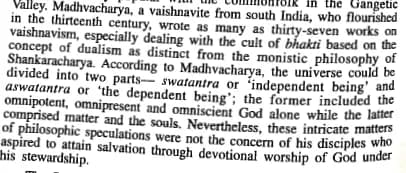
Madhava and Brahma Mimamsa
- ! book called Bharatatatparyanirnaya based on Puranas and epics
- ! Madhava wrote commentaries on Brahmasutra and Upanishads,
- Rejected the idea God was the cause for creation of world
- God completely different from individual soul and world
- Individual soul has many defects, can be removed by worshipping God
- God-Soul is a link b/w master and servant
Art and Architecture
Hoysala Art and Architecture
- Near Mysore from 1050-1300 AD in areas of Belur, Halebid and Sringeri
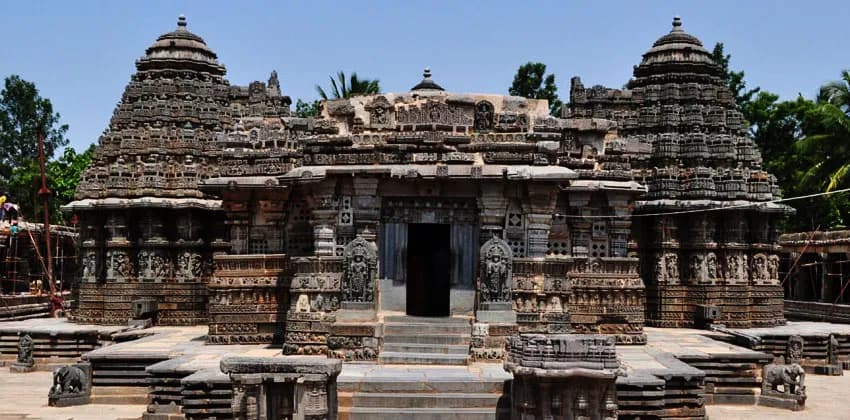
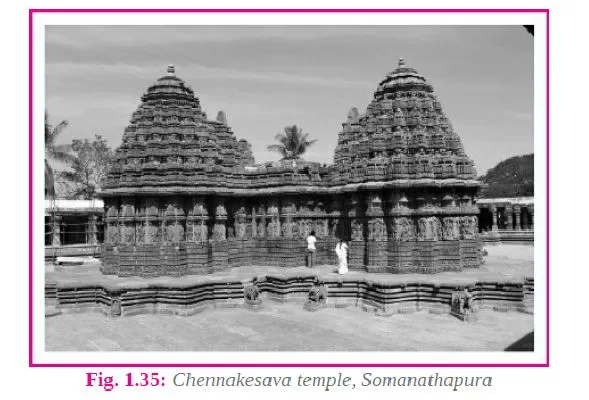
- Multiple shrines built around a central pillared hall
- shrines led out in the shape of an intricately designed star aka Stellate plan
- Soft soap stone (Chorite schist) was the main building material.
- Massive emphasis on decoration of temple through sculptures
- Shikharas interconnected by arrangement of horizontal lines and mouldings
- Temples built on upraised platform known as Jagati
- walls and stairs followed a zig zag pattern
- Noted for fine, delicate, detailed carvings executed on smooth chlorite schist on walls and ceilings
- Hoysaleshvara temple : cruciform plan, cruciform shape, two separate shrines,
- Keshava temple : at Belur has multiple shrines, finesse in sculptures
- Keshava temple : at Somnathpur has complex plan, Shikhara of moderate height, richly carved, has erotic themes
Hoysala Literature
- Royal patronage of Kannada increased and a Champu style of literature flourished during this time.
- Poetic devices such as Sangatya metre, Shatpadi, tripadi, etc metres were used to write poems.
- Scholars such as Janna, Rudrabhatta, Harihara etc lived during Hoysala rule.
- Janna wrote Yadshodharacharita he was given the title of Kavichakravartin for this.
- Rudrabhatta was patronised by Chandramouli minister of Veera Ballala II he wrote Jagannatha Vijaya in Champy style
- Harihara wrote Girijakalyana.